
Credit Card Processing: The Master Guide to Cost Control
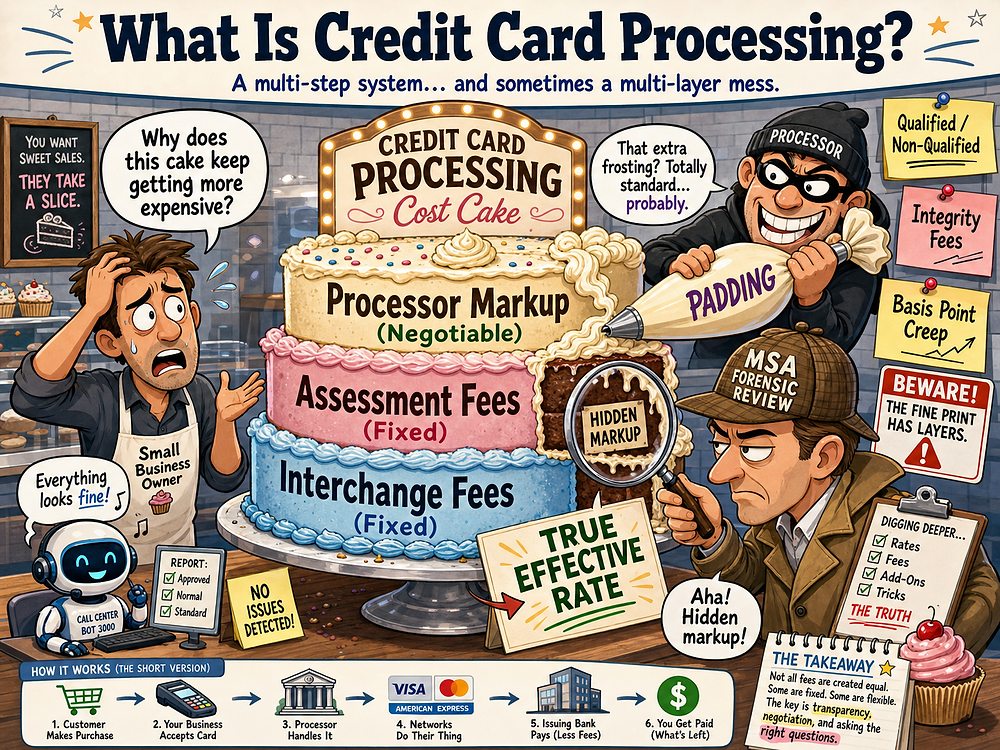
What is Credit Card Processing?
Credit card processing is the multi-step system that allows businesses to accept non-cash payments. It involves the electronic transfer of data and funds between a merchant, an acquiring bank, the card networks (Visa/Mastercard), and the card-issuing bank. For business owners, the "cost" of credit card processing is the sum of interchange fees, network assessments, and processor markups.
Expert Verified & Fact-Checked
- From the Desk of: Chris DuPont, a veteran of Merchant Statement Analysis for over 17 years (merchant-statement-analysis.com)
- The Data: Updated March 2026. This guide uses live data from the most recent April/October card brand fee updates.
- Our Approach: We treat credit card processing as an engineering challenge. By isolating fixed costs from negotiable markups, we empower CFOs to eliminate waste without switching processors.
How Credit Card Processing Costs Are Calculated
To control your rates, you must understand the three-layer cost cake. Most "teaser" quotes only show you the top layer, hiding the inefficiencies beneath.
- Interchange Fees (Fixed): Paid to the card-issuing bank. These are non-negotiable and vary by card type (e.g., Debit vs. Corporate Rewards).
- Assessment Fees (Fixed): Paid directly to Visa, Mastercard, or Discover for network usage.
- Processor Markup (Negotiable): The only area where your business can save money. This includes the "spread" the processor keeps for their services.
Identifying "Padding" in Your Processing Rates
Even if you have a competitive markup, processors often hide additional profit through Interchange Fee Padding. This occurs when a processor quotes you a "pass-through" rate but adds a small, invisible margin to the raw interchange costs.
Red Flags in Your Merchant Statement:
- Bundled Tiers: If your statement uses terms like "Qualified" or "Non-Qualified," your true costs are being masked.
- Integrity Fees: Small per-transaction fees (often $0.10 or higher) labeled as "Network Fees" that do not match official card brand tables.
- Basis Point Creep: A gradual increase in your fixed percentage markup over 12–24 months without a formal rate increase notice.
The MSA Forensic Review: Our 5-Step Process
We don't just "look" at your processing; we perform a forensic audit to uncover every lost cent.
1. Raw Data Extraction
We bypass the "Summary" page of your statement and extract the raw transaction data to see exactly how each card type was cleared.
2. Interchange Optimization
We identify "Downgrades"—transactions that cost more because they lacked data like a Zip Code or Invoice Number—and implement the technical fixes to reclaim those margins.
3. Markup Isolation
We calculate your True Effective Rate by stripping away the non-negotiable network costs. This reveals exactly how much your processor is profiting from your volume.
4. B2B Level 2 & 3 Validation
For B2B companies, we ensure your system is sending the enhanced data required to trigger lower "Commercial" interchange rates, which can save up to 1% per transaction.
5. Profit Engineering Report
We provide a roadmap to move your business to a transparent Interchange-Plus model, ensuring you only pay the "wholesale" price plus a fixed, fair markup.
Strategic Shift: Transactional vs. Consultative
Feature
Transactional Processing
MSA Profit Engineering
Pricing Focus
Lowest "Teaser" Rate
Lowest Effective Rate
Review Cycle
Once every 3 years
Ongoing Monthly Monitoring
Support
Call Center / AI Bot
17-Year Industry Veteran
Goal
Just "Accepting Cards"
Maximizing Bottom-Line Profit
Frequently Asked Questions (FAQ)
"What is a fair markup for credit card processing?"
For mid-to-high volume businesses, a fair markup typically ranges from 10 to 30 basis points (0.10% – 0.30%) above raw interchange.
"Why did my processing rates go up suddenly?"
Card brands usually update their interchange tables in April and October. However, if your rates increased outside of these windows, it is likely a processor-initiated "margin expansion."
"Can I lower my rates without switching banks?"
Yes. Through Interchange Optimization, MSA can often lower your total costs by correcting technical downgrades and negotiating your current markup without the hassle of a bank move.